

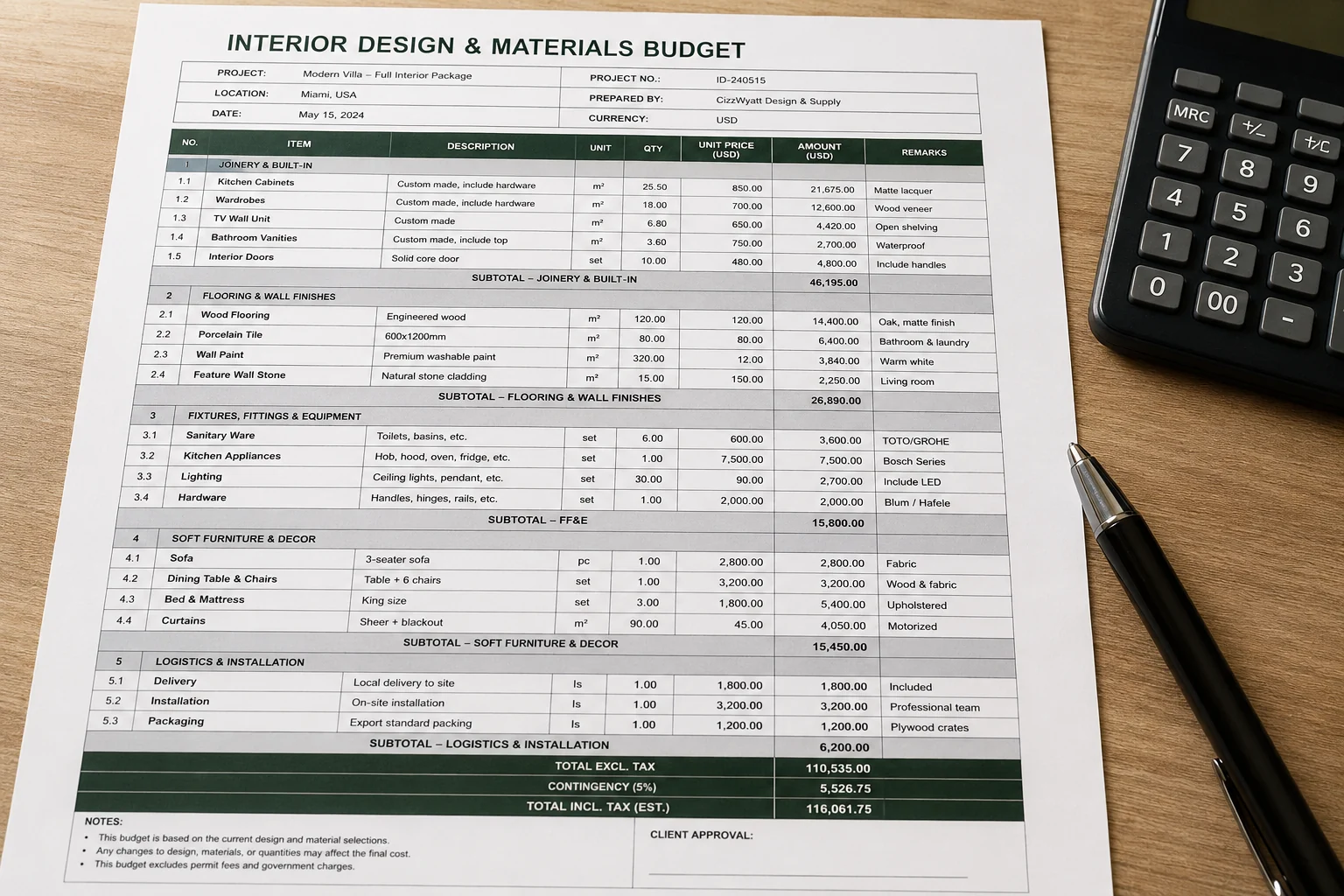
From a factory-side perspective, a project budget is not simply unit price multiplied by quantity. A useful budget is a control system that connects design decisions, material specifications, production, quality checks, packaging and delivery.
If the budget is prepared only after the design is finished, many expensive decisions have already been locked in. If it is prepared too roughly, the quotation may look attractive at the beginning but become difficult to execute later.
For overseas residential, hospitality and commercial interior projects, the right question is not “what is the cheapest price?” but “what cost structure can protect the design intent and still be delivered reliably?”
Factory takeaway
A good interior project budget should protect three things at the same time: design intent, delivery reliability and financial predictability.
01 / Budget Logic
A budget should translate design intent into executable decisions
On the factory side, we read a budget as a chain of decisions. A cabinet drawing becomes board thickness, surface finish, hardware grade, edge treatment, packaging method and installation requirement. A stone wall becomes slab selection, loss rate, cutting method, reinforcement and shipping protection.
This is why a good budget must be built from specifications, not from vague item names. “Wood veneer cabinet” is not enough. The budget needs to define substrate, veneer type, lacquer level, hardware range, internal accessories, quantity, delivery method and quality standard.
02 / Scope Before Price
Incomplete information creates false savings
The most common budget mistake is asking for a price before the project scope is stable. When areas, quantities, finish levels and technical requirements are unclear, every supplier fills the gaps with their own assumptions. The numbers may be comparable on paper, but they are not comparable in execution.
A lower quotation may exclude door hardware, installation accessories, reinforced packaging, sample confirmation, shop drawings, extra loss allowance, or destination delivery support. These omissions are not always visible at the beginning, but they become real costs later.
03 / Main Cost Blocks
Five areas decide most of the final project cost
In our quotation workflow, we separate the budget into cost blocks so the client can understand where the money is going. This prevents one large number from hiding important decisions.
The five core blocks are design and technical coordination, materials and finishes, custom production, quality control and packaging, and logistics or delivery. A realistic budget also needs a contingency reserve for design changes, site changes and quantity adjustment.
- Design coordination: concept refinement, drawings, specification alignment and supplier communication.
- Material cost: base material, finish grade, sample confirmation, loss rate and replacement risk.
- Production cost: customization level, craft complexity, machine time, labor and production scheduling.
- QC and packaging: inspection steps, protective packing, export packing and labeling.
- Delivery cost: consolidation, loading, shipping method, documentation and destination coordination.
04 / Hidden Risk
The cheapest budget is often the one with the most missing details
In factory work, we see many projects lose control not because the client chose expensive materials, but because early decisions were not fully priced. Small details such as hinges, handles, edge sealing, moisture resistance, crate size and container loading can change the final cost.
Another hidden risk is redesign after procurement starts. If a material is changed after samples, shop drawings or production preparation, the cost impact is not only the price difference of the material. It may also affect lead time, production sequence, packing list and delivery schedule.
- Quotation without clear exclusions.
- Finish samples approved too late.
- Quantities estimated without drawings or site dimensions.
- Packaging and shipping protection treated as afterthoughts.
- Budget compared only by item price instead of total delivery responsibility.
05 / Factory Method
How CizzWyatt builds a more controllable budget
Our preferred method is to connect budgeting with design and procurement at the same time. We review the design intent, define product categories, confirm material direction, identify production difficulty, and separate fixed costs from variable costs.
For custom interiors, we also check whether the design can be produced consistently, packed safely and delivered with acceptable risk. A budget that ignores production reality is not a budget; it is only a number.
This factory-side review helps the client see which decisions are worth investing in and which details can be adjusted without damaging the final effect.
06 / Client Preparation
A better brief creates a better budget
Before asking for a project budget, clients should prepare basic information. This does not need to be perfect, but it should be clear enough for the design and factory teams to understand the level of work required.
The most useful information includes location, property type, approximate area, rooms included, preferred style, required product categories, expected quality level, budget range, delivery destination and target timeline.
- Floor plans, dimensions and site photos.
- Reference images with notes on what you like and dislike.
- A priority list: appearance, durability, budget, speed or maintenance.
- A clear shipping destination and expected completion date.
07 / Smarter Questions
Ask for the cost logic, not only the final number
A serious budget discussion should make the project easier to control. Instead of asking only for the lowest price, clients should ask what is included, what is excluded, what assumptions are used, which items are most sensitive to change, and how the quotation connects to production and delivery.
When these questions are answered early, the budget becomes a decision-making tool. It helps the client choose where to invest, where to simplify and how to reduce risk before money is committed.
Conclusion
If the budget only pursues a low first number, the project may pay later through redesign, rework, material replacement, delivery delay or quality dispute. If the budget is built from real specifications and factory logic, it becomes a practical roadmap for the whole project.
At CizzWyatt, we do not treat budgeting as a spreadsheet task only. We treat it as the bridge between design ambition and factory delivery.